 跳到内容
跳到内容 


Abstract
Pillow height, commonly known as loft, is one of the most critical factors in memory foam pillow design and performance. While buyers often focus on cover materials and product appearance, loft directly affects cervical alignment, pressure distribution, and long-term comfort during sleep cycles.
For B2B buyers sourcing ergonomic neck support pillows in volume, understanding loft selection helps reduce return rates, improve product positioning, and create stronger market differentiation. This guide explores cervical support principles, sleep position-based loft recommendations, memory foam specifications, and key sourcing considerations for developing high-performance pillow products.
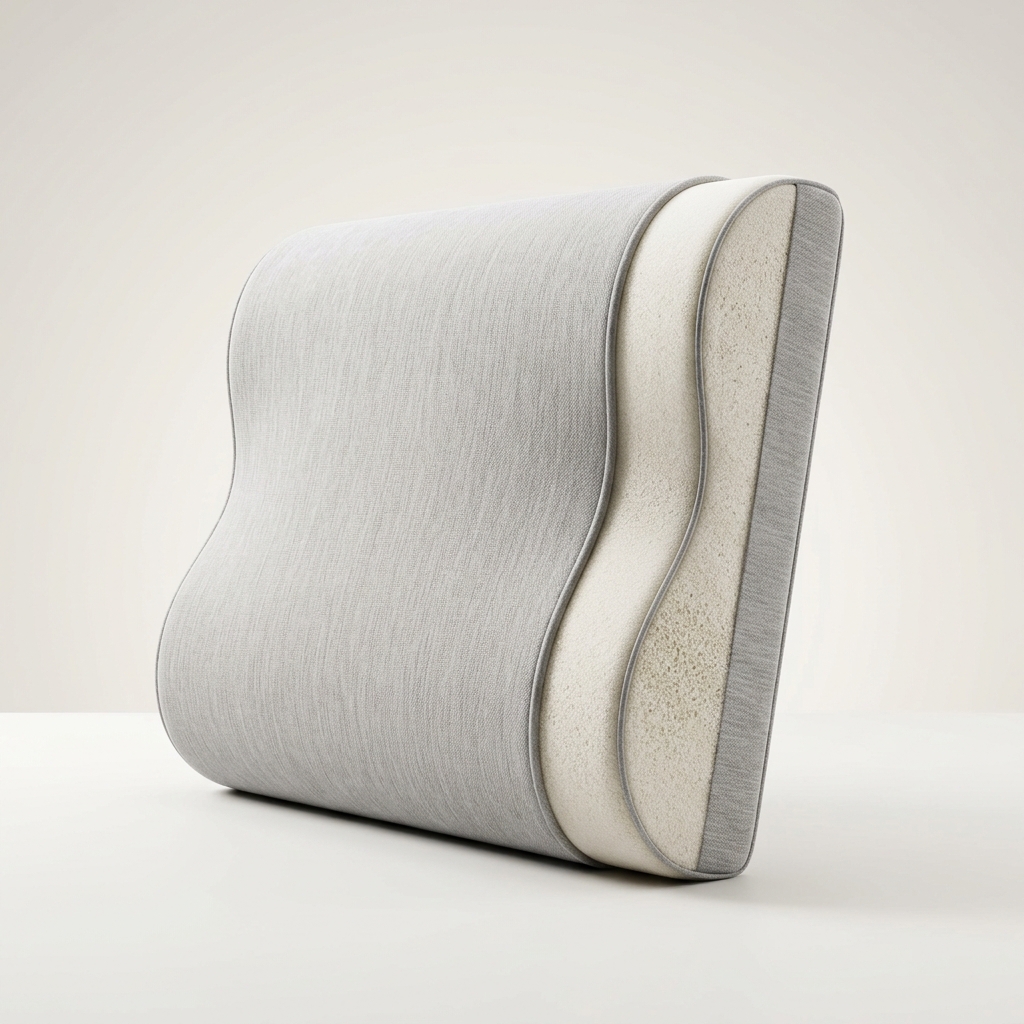
The Science Behind Pillow Height and Cervical Spine Alignment
How Loft Affects Neck Posture and Pressure Distribution
The cervical spine consists of seven vertebrae (C1–C7) that naturally form a gentle curve to support head movement and stability. When a pillow’s loft does not match the sleeper’s body shape and sleeping position, the neck may move away from its neutral alignment, creating unnecessary strain and reducing overall comfort.
Pillow height also influences pressure distribution. A pillow that is too high, too low, or overly firm may create concentrated pressure around the head and neck area instead of providing balanced support. An ergonomically designed memory foam pillow helps distribute weight across a wider contact area while maintaining proper cervical support throughout the night.
For manufacturers and buyers developing ergonomic sleep products, understanding the relationship between loft, pressure distribution, and body alignment is essential for selecting the right specifications and improving user satisfaction.
Why Standard Pillows Fail and Where Memory Foam Fills the Gap
Traditional fiberfill pillows often lose their original shape after repeated compression, which can reduce effective loft and affect long-term support performance. Latex materials provide good resilience, but their response characteristics may not offer the same level of contouring adaptability for different neck and shoulder shapes.
A memory foam pillow uses viscoelastic foam technology that responds to both body heat and pressure. As the material warms, it gradually conforms to the contours of the head and neck, helping spread pressure more evenly across the surface. Once pressure is removed, the foam slowly returns to its original structure, helping maintain consistent support over time.
This adaptive response is one of the key reasons memory foam is widely used in ergonomic pillow designs. For B2B buyers, selecting the right foam density, firmness, and response rate is critical to developing a memory foam pillow that balances comfort, durability, and market expectations.
Recommended Pillow Height by Sleep Position
Side, Back, and Stomach Sleepers — Loft Ranges and Rationale
Sleep position is the primary determinant of required loft. The goal in every position is to keep the cervical spine collinear with the thoracic spine — a straight horizontal axis from the base of the skull to the mid-back when viewed from the front or rear.
| Sleep Position | Recommended Loft Range | Target Cervical Angle | Suggested Memory Foam Density | Notes / Contraindications |
|---|---|---|---|---|
| Side Sleeper | 4–6 inches | 0–5° lateral deviation | 4.0–5.0 lb/ft³ | Loft should approximate shoulder width; broader shoulders require higher end of range |
| Back Sleeper | 3–5 inches | 0–5° posterior tilt | 3.5–4.5 lb/ft³ | Avoid loft above 5 in; excessive height pushes chin toward chest |
| Stomach Sleeper | 2–3 inches | Minimal elevation preferred | 3.0–3.5 lb/ft³ | Low loft reduces cervical rotation stress; stomach sleeping generally discouraged for chronic neck pain |
| Combination Sleeper | 3–5 inches (adjustable) | Variable | 3.5–4.5 lb/ft³ | Adjustable-loft design strongly recommended |
Side sleepers require the highest loft because the pillow must bridge the distance between the mattress surface and the ear, compensating for shoulder width — typically 4 to 6 inches for average adults. Back sleepers need moderate loft to support the natural cervical curve without pushing the head forward. Stomach sleepers benefit from minimal elevation to reduce the rotational torque applied to cervical joints during prolonged prone positioning.
Adjustable Loft Design — A Scalable Solution for Diverse User Profiles
For B2B buyers managing SKU complexity across diverse retail or hospitality channels, adjustable-loft memory foam pillows offer a compelling consolidation opportunity. Shredded memory foam fill allows end users to add or remove material through a concealed zipper, tuning loft to their specific body geometry and sleep position. Dual-layer constructions — pairing a firm base layer with a softer adaptive top layer — achieve a similar result with greater manufacturing consistency.
From a commercial standpoint, a single adjustable SKU can replace two to three position-specific variants without sacrificing performance claims. This reduces warehouse footprint, simplifies reorder logistics, and supports a broader addressable market within a single product listing — a meaningful advantage for private label programs targeting multi-channel distribution.
Memory Foam Specifications That Drive Neck Support Performance
Key Material Parameters — Density, ILD, and Response Time
The performance of a memory foam pillow depends largely on three key material specifications: density, ILD (Indentation Load Deflection), and response time. These factors directly influence durability, firmness, contouring ability, and overall support performance.
- Density (lb/ft³):
Density indicates the amount of foam material within a given volume and is closely related to durability and support consistency. For ergonomic neck support applications, memory foam with a density range of approximately 3.5–5.0 lb/ft³ is commonly selected to achieve a balance between resilience and comfort. Lower-density foam may lose support faster under repeated use, while higher-density formulations require careful adjustment to maintain flexibility and pressure response. - ILD (Indentation Load Deflection):
ILD measures foam firmness by determining the force required to compress the material by 25% of its thickness. For cervical support products, a balanced ILD value helps a memory foam pillow provide both initial comfort and stable support. The ideal specification depends on product design, target users, and the desired sleeping experience. - Response Time:
Response speed affects how quickly the foam adapts and recovers after pressure is applied. Slow-rebound memory foam provides deeper contouring, while faster-rebound options allow easier repositioning for combination sleepers. For bulk purchasing, buyers should clearly define response time requirements to ensure product consistency across production batches.
Compliance Standards and Certifications Buyers Must Verify
For international markets, certification compliance is an important factor when sourcing a memory foam pillow from overseas manufacturers. Verified documentation helps buyers ensure product safety, meet regional regulations, and build consumer trust.
Key certifications commonly requested include:
- CertiPUR-US®: Confirms that the foam meets requirements related to chemical emissions, prohibited substances, and material safety for the US market.
- OEKO-TEX® Standard 100: Tests product components, including fabrics and fillings, for harmful substances and is widely recognized in global textile markets.
- ASTM E1590 / Cal TB 117-2013: Relevant safety standards for specific upholstered and bedding applications in the US.
- REACH Compliance: Required for many European markets to control restricted substances and ensure regulatory compliance.
When sourcing from international suppliers, buyers should request valid third-party test reports, confirm certificate details, and verify that documentation matches the exact foam formulation and finished product being ordered.
Key Sourcing Considerations for Ergonomic Neck Support Pillows
OEM/ODM Customization — Loft, Cover Fabric, and Branding Options
The ergonomic sleep category rewards differentiation. Leading manufacturers offer OEM/ODM programs that allow buyers to specify:
- Loft configuration: Fixed height, adjustable shredded fill, or dual-layer construction
- Cover materials: Bamboo-derived rayon (moisture-wicking, sustainable positioning), Tencel™ lyocell (premium softness, biodegradable), or cooling knit with phase-change material integration
- Branding: Woven labels, custom zipper pulls, full-color inner bag printing, and retail-ready packaging with clinical messaging
Minimum order quantities for private-label memory foam pillows typically range from 500 to 2,000 units per SKU, depending on the complexity of foam specifications and the level of cover customization. Buyers consolidating multiple cover variants onto a shared foam core can often negotiate lower aggregate MOQs.
Total Cost of Ownership vs. Per-Unit Price — A Buyer’s Framework
Unit price is a misleading primary metric for memory foam pillow procurement. A pillow priced 15% lower but manufactured with 2.8 lb/ft³ foam will generate disproportionate return and replacement costs within 12–18 months as the foam loses loft integrity. A structured TCO evaluation should include:
- Warranty period: Industry benchmark is 3–5 years for quality memory foam pillows. Suppliers offering less than 2 years signal low-density foam use.
- Return rate benchmarking: Target a defect-driven return rate below 2%. Comfort-driven returns are reduced when loft guidance and sleep position matching are included in packaging.
- Supplier qualification: Audit production consistency through foam density sampling (minimum 5 units per batch), and require ILD certification per production lot for high-volume orders.
FAQ
1. What is the ideal pillow height for side sleepers with chronic neck pain? Side sleepers with chronic neck pain should prioritize a loft of 4–6 inches, calibrated to their specific shoulder width. Memory foam density of 4.0–5.0 lb/ft³ ensures the pillow doesn’t compress below therapeutic loft under sustained head weight. Adjustable-fill designs allow fine-tuning without requiring multiple SKUs.
2. How do I verify that a memory foam pillow meets international safety and material certifications before placing a bulk order? Request current CertiPUR-US® and OEKO-TEX® Standard 100 certificates with visible certificate numbers, then validate directly on the issuing organization’s website. For EU-bound products, additionally confirm REACH compliance documentation. All certificates should reflect the specific foam formulation and cover material used in your order, not a generic factory-level approval.
3. Can a single memory foam pillow SKU serve multiple sleep positions, or do we need position-specific variants? An adjustable-loft shredded memory foam pillow with a loft range of approximately 3–6 inches can functionally serve side, back, and combination sleepers within a single SKU. Stomach sleepers represent a distinct profile requiring a dedicated low-loft variant (2–3 inches). For most B2B programs, a two-SKU strategy — one adjustable and one low-loft — covers the majority of consumer profiles efficiently.
Conclusion
Pillow loft selection is a clinical and commercial decision with measurable downstream consequences. Memory foam’s viscoelastic response, durability across density ranges of 3.5–5.0 lb/ft³, and compatibility with adjustable-loft constructions make it the most defensible material platform for ergonomic neck support across all sleep positions. B2B buyers who align sourcing specifications with biomechanical benchmarks — and who rigorously verify certifications and TCO metrics — are positioned to reduce returns, build credible product claims, and capture sustained demand in the fast-growing ergonomic sleep segment. The competitive advantage lies not in price, but in specification precision.
 English
  French
  German
  Japanese
  Korean
  Latvian
  Russian
  Spanish
  Arabic
  Dutch
Dutch  Ukrainian