 Aller au contenu


Introduction
Memory foam mattresses have become a popular choice in the global sleep products market due to their pressure-relieving comfort, motion isolation, and adaptable support. For hotels, retailers, and healthcare facilities, choosing the right memory foam mattress requires more than comparing prices — foam density, firmness, layer construction, and certifications all affect long-term performance.
This guide explains the key factors buyers should evaluate when selecting a memory foam mattress, including foam technology, firmness selection by sleep position and body type, quality certifications, and total cost considerations. Whether you are purchasing for hospitality projects, retail distribution, or healthcare applications, these insights can help you make more reliable sourcing decisions and select products that deliver consistent comfort and durability.
1. Understanding Memory Foam Technology & Core Specifications
1.1 Foam Density, ILD Rating & Layer Construction
The performance of any Matelas en mousse à mémoire de forme is largely determined by two key specifications: foam density (measured in pounds per cubic foot, PCF) and Indentation Load Deflection (ILD, also known as IFD). Understanding how these factors work together and how they are applied across different mattress layers helps buyers evaluate quality, comfort, and long-term durability.
Density (PCF) refers to the amount of foam material contained within each cubic foot. In general, higher-density foam provides better durability, motion isolation, and body contouring support, making it an important consideration for both residential and commercial applications.
- 2.0–3.0 PCF: Entry-level foam suitable for guest rooms, occasional-use spaces, or short-term rental applications. Under moderate use, these mattresses typically provide around 4–6 years of service life.
- 3.0–4.0 PCF: A common mid-range specification that offers a practical balance between cost and performance. This density range is widely used in hotels and other applications requiring reliable daily comfort.
- 4.0–5.0+ PCF: Premium-grade foam designed for applications requiring enhanced durability, deeper contouring, and improved pressure relief. It is often selected for healthcare facilities, senior living environments, and high-end hospitality projects.
ILD (Indentation Load Deflection) measures mattress firmness by determining the amount of force required to compress a 4-inch foam sample by 25%. Lower ILD values indicate a softer feel, while higher ILD values provide firmer support.
Layer construction is another important factor affecting overall mattress performance. A well-designed Matelas en mousse à mémoire de forme typically combines multiple layers, including a comfort layer (usually 2–4 inches of memory foam with lower ILD for pressure relief) and a high-density support layer (around 6–8 inches with higher PCF for structural stability). Premium designs may also include a transition layer to create a smoother balance between cushioning and support while improving long-term performance.
For commercial purchasing, buyers should request detailed specifications for each foam layer rather than relying on a single overall density number. Reviewing the construction of both comfort and support layers provides a clearer understanding of mattress quality and expected service life.
1.2 Foam Types Comparison: Traditional vs. Gel-Infused vs. Open-Cell
Foam composition has a direct impact on temperature regulation, responsiveness, durability, and VOC performance. These factors are especially important when selecting a memory foam mattress for hotels, healthcare facilities, and other high-use environments.
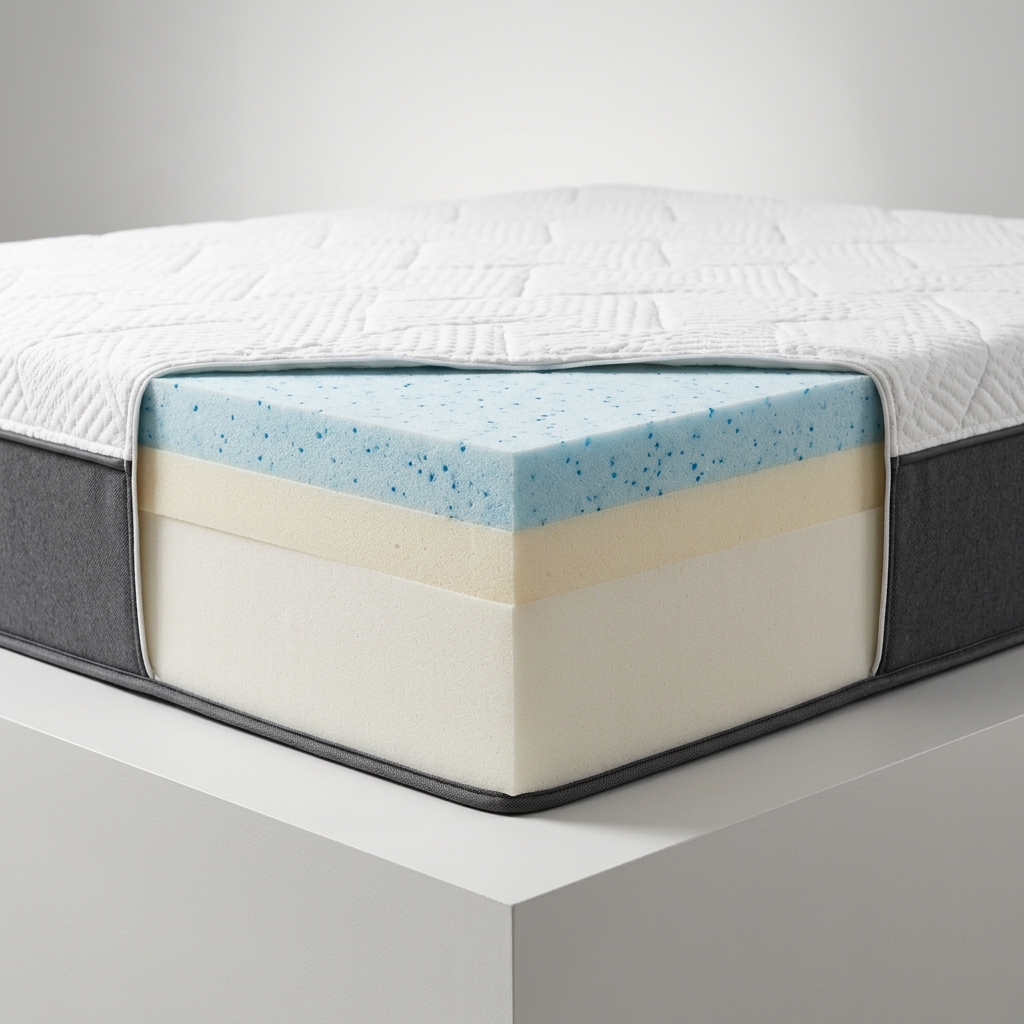
1.2 Foam Types Comparison: Traditional vs. Gel-Infused vs. Open-Cell
Foam chemistry significantly affects thermal performance, response time, and off-gassing profiles — all critical factors in commercial deployment.
| Foam Type | Density Range (PCF) | ILD Range | Thermal Rating | Application Fit | Certifications | MOQ Price Range (per unit) |
|---|---|---|---|---|---|---|
| Traditional Memory Foam | 2.5–5.0 | 10–30 | Low (heat-retaining) | Budget hotel / Residential | CertiPUR-US | $80–$220 |
| Gel-Infused Memory Foam | 3.0–5.0 | 12–28 | Medium (phase-change cooling) | Mid-scale hotel / Retail | CertiPUR-US / OEKO-TEX | $120–$320 |
| Open-Cell Memory Foam | 3.0–4.5 | 14–26 | High (airflow-enhanced) | Premium residential / Healthcare | CertiPUR-US / OEKO-TEX | $150–$380 |
Traditional memory foam offers the lowest cost-per-unit and proven durability but retains body heat — a persistent complaint in warmer climates or poorly ventilated rooms. Gel-infused variants integrate phase-change gel beads or swirl patterns to dissipate heat, reducing surface temperature by 1–3°C in controlled testing. Open-cell foam restructures the polymer matrix to allow continuous airflow, offering the best thermal performance but at a higher production cost and with a slightly faster compression response time, which some sleepers perceive as less conforming.
Off-gassing (VOC emission) is a procurement concern particularly for healthcare and children’s product channels. Open-cell and gel-infused foams generally off-gas faster post-production due to their porous structure, clearing to acceptable VOC thresholds within 24–48 hours versus 48–72 hours for traditional foam.
2. Matching Mattress Firmness to Sleep Position & Body Type
2.1 Firmness Scale Mapping by Sleep Position
Firmness is one of the most important factors affecting comfort and support when selecting a Matelas en mousse à mémoire de forme. Matching ILD ratings with different sleep positions helps buyers choose suitable specifications for various user groups and commercial applications.
- Side sleepers typically benefit from soft to medium firmness (ILD 14–19). Because the shoulders and hips create higher pressure points, adequate contouring is important for reducing pressure buildup and improving sleeping comfort. For hotels and other projects where guest sleep preferences are unavailable, side-sleeper-friendly specifications are often considered a practical choice, as side sleeping represents one of the most common sleep positions among adults.
- Back sleepers usually perform well on medium-firm surfaces (ILD 20–25). This range provides balanced support for the lumbar area while preventing excessive sinking, helping maintain a more neutral sleeping posture.
- Stomach sleepers generally require firmer support (ILD 25–31) to reduce excessive hip sinking and maintain proper body alignment. Although this group represents a smaller percentage of sleepers, incorrect firmness selection can significantly affect comfort.
- Combination sleepers who change positions throughout the night often benefit from medium firmness (ILD 19–23). This range provides a balance between pressure relief and support, making it a suitable option for applications where one Matelas en mousse à mémoire de forme specification needs to accommodate different sleeping habits.
2.2 Weight Distribution & Pressure Point Considerations
Body weight directly influences how a mattress feels in actual use. The same ILD rating can provide different levels of support depending on the sleeper’s weight, because heavier users typically compress foam layers more deeply than lighter users. When selecting a Matelas en mousse à mémoire de forme for different user groups, buyers should consider the following weight ranges:
- Under 130 lbs: Lighter sleepers may not fully engage firmer foam layers. Softer comfort layers (ILD 14–17) with a base density of around 3.0–3.5 PCF can provide adequate contouring and comfort.
- 130–230 lbs: This range represents the most common user profile. A 3.5–4.0 PCF support layer combined with an ILD range of 18–25 generally provides a balanced combination of durability, support, and comfort.
- Over 230 lbs: Higher body weight places greater stress on foam materials over time. A minimum base density of 4.0 PCF, comfort layer ILD of 22–28, and reinforced support structures can help reduce premature compression and body impressions.
For healthcare facilities and senior living environments, zoned support designs can provide additional pressure distribution and support where users require enhanced comfort and long-term durability.
3. Compliance Standards, Certifications & Supply Chain Due Diligence
3.1 Key Certifications Required by Market
Certification requirements for a Matelas en mousse à mémoire de forme vary depending on the target market, application, and sales channel. Understanding these requirements before supplier evaluation can help buyers avoid delays, additional testing costs, and compliance issues during product development.
- CertiPUR-US: Widely recognized for US residential, retail, and hospitality markets. It verifies that foam materials are tested for substances such as ozone depleters, heavy metals, formaldehyde, and VOC emissions. Buyers should confirm certificate validity because certifications are typically updated on a regular basis.
- OEKO-TEX Standard 100: Commonly required for European markets and increasingly requested by premium retailers worldwide. Unlike foam-only certifications, it evaluates the safety of the complete textile-related components, including mattress covers and other materials that may come into contact with users.
- Conformité REACH : Required for products entering the European market. This regulation controls restricted chemical substances and helps ensure that mattress materials meet EU safety requirements.
- ISPA Membership: While not a product certification, membership can serve as an additional indicator of supplier credibility within the mattress industry, particularly for hospitality and commercial buyers.
3.2 Quality Verification: Factory Audit Checkpoints & Testing Protocols
Supplier certificates alone do not provide a complete picture of product quality. Before purchasing a Matelas en mousse à mémoire de forme for commercial applications, buyers should review testing data and evaluate manufacturing capabilities through the following checkpoints:
- ASTM D3574 Test Reports: These reports evaluate important foam properties, including tensile strength, elongation, tear resistance, and compression set. Compression performance is especially important because it directly affects long-term durability and resistance to permanent body impressions.
- Rollator Testing: Commercial hospitality projects commonly require durability testing of 75,000 cycles or more, while healthcare applications may require 100,000+ cycles. These tests simulate repeated use and help measure foam recovery and body impression performance over time.
- VOC Emission Testing: Third-party air chamber testing provides more reliable information than material declarations alone. This is especially important for healthcare facilities, children’s products, and other environments with strict indoor air quality requirements.
Factory Audits: Buyers should verify foam pouring consistency, layer bonding methods, production controls, and cover stitching quality. Consistent manufacturing processes help maintain stable ILD values and ensure product performance across different production batches.
4. Commercial Application Scenarios & Total Value Assessment
4.1 Segment-Specific Sourcing Priorities
Different commercial applications require different Matelas en mousse à mémoire de forme specifications. Selecting the right construction based on usage conditions can improve durability, user satisfaction, and long-term value.
Hospitality: Hotels typically prioritize durability, consistent firmness, and easy maintenance. Recommended specifications include rollator-tested performance (75,000+ cycles), removable and washable covers, antimicrobial treatments, and medium-firm comfort levels. In the US market, fire safety compliance such as 16 CFR Part 1633 is also required.
Residential Retail: Retail products require a wider range of firmness options, including soft, medium, and firm models, to meet different consumer preferences. Efficient packaging solutions such as roll-pack compression can help reduce transportation costs and improve distribution efficiency.
Healthcare & Senior Living: These applications require higher durability and support performance. Common specifications include a minimum 4.0 PCF support layer, zoned lumbar and hip support, waterproof cover materials, and verified safety certifications. Pressure mapping data can also help evaluate pressure distribution performance.
4.2 Cost-Per-Night Calculation & Long-Term ROI for Bulk Buyers
For commercial buyers, the real value of a memory foam mattress is determined not only by purchase price but also by service life, maintenance requirements, and replacement frequency. Cost-per-occupied-night (CPON) provides a more accurate way to evaluate long-term investment.
Formula:
CPON = Unit Cost ÷ (Annual Occupied Nights × Service Life in Years)
For example, a $180 mattress with a 5-year service life and 300 occupied nights per year has a CPON of approximately $0.12. A higher-quality $280 mattress with 4.0 PCF density and an 8-year lifespan can reduce the CPON to around $0.117 while potentially lowering replacement frequency and customer complaints.
Foam density is one of the most important factors affecting mattress lifespan. Increasing the base layer density by 0.5 PCF can significantly improve resistance to compression and extend usable performance. For a 500-room hotel, choosing a higher-density specification may reduce long-term replacement costs and improve operational efficiency.
FAQ
Q1: What foam density is recommended for a memory foam mattress used in hotels?
For commercial hotel use, a support layer density of 4.0 PCF or higher is recommended for long-term durability. Buyers should also review rollator testing results, compression set data, and overall layer construction to confirm the expected service life.
Q2: How can I verify a supplier’s CertiPUR-US certification before purchasing a memory foam mattress?
Check the supplier’s certificate details through the official CertiPUR-US database and confirm the issue and expiration dates. Buyers should request valid documentation and verify that the certification applies to the specific foam formulation being supplied.
Q3: Can one memory foam mattress specification work for both side and back sleepers?
Yes. A medium-firm memory foam mattress with an ILD range of around 19–22 can provide a balance of pressure relief and support. This specification is commonly used for hotels where one mattress model needs to suit different sleeping preferences.
Q4: What certifications should buyers check before purchasing a memory foam mattress?
Common certifications include CertiPUR-US, OEKO-TEX Standard 100, and REACH compliance. These certifications help verify foam safety, material quality, and chemical compliance for different markets and applications.
Q5: How can buyers reduce replacement costs when purchasing memory foam mattresses in bulk?
Focus on total value rather than initial price. Higher-density foam, reliable testing data, and suitable construction can improve durability, reduce replacement frequency, and lower long-term operating costs.
Q6: What factors affect the lifespan of a memory foam mattress?
Mattress lifespan depends on foam density, layer construction, usage frequency, sleeper weight, and maintenance conditions. Higher-quality materials and proper specifications generally provide better long-term performance.
Conclusion
Selecting the right memory foam mattress requires careful evaluation of foam density, ILD rating, layer construction, certifications, and long-term durability. By focusing on product performance rather than price alone, buyers can reduce replacement costs and improve user satisfaction across hospitality, retail, and healthcare applications.
For bulk orders or customized mattress solutions, contact Fuying to discuss your requirements and find the right memory foam mattress specifications for your market.
 French
  English
  German
  Japanese
  Korean
  Latvian
  Russian
  Spanish
  Arabic
  Dutch
Dutch  Ukrainian